
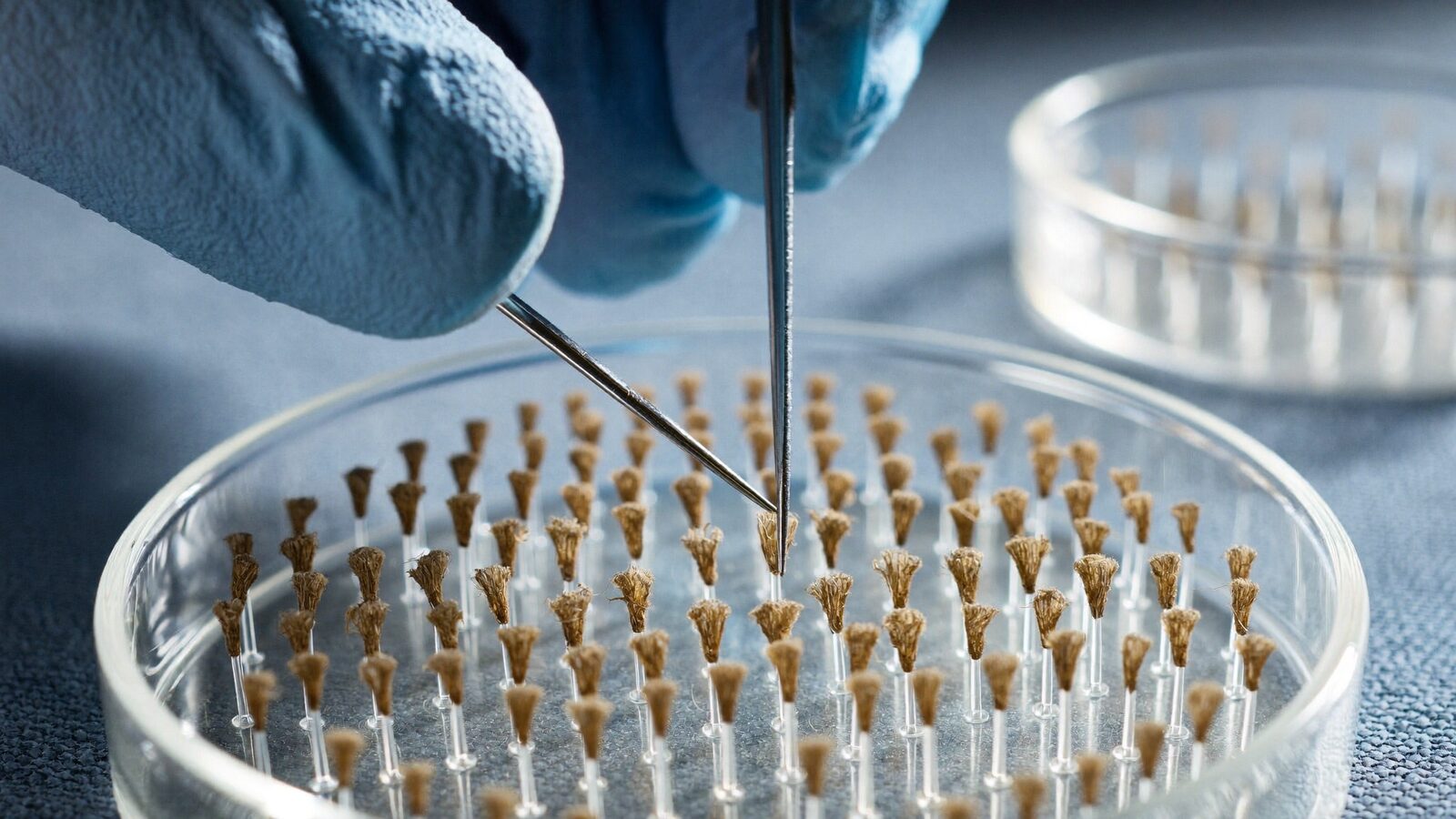
The real answer to DHI vs FUE is that they are not competing surgeries. DHI (direct hair implantation) is one way of placing grafts that were already harvested by FUE (follicular unit extraction), using a spring-loaded implanter pen instead of fine forceps. The donor work is identical; only the final placement step changes. At our Newton clinic, DHI-style placement with an implanter pen is offered alongside classic placement, and the choice is made zone by zone.
That framing matters because many patients arrive believing they must pick one technique or the other, sometimes after seeing ads that treat DHI as a newer, superior procedure. This guide explains what the pen actually does, where it earns its place, where it mostly adds time and cost, and how to decide with your surgeon what fits your scalp.
Key takeaways
- DHI is a graft placement method used inside an FUE procedure, not a separate way of harvesting hair.
- In both approaches, grafts are removed one at a time from the back and sides of the scalp with a small round punch.
- An implanter pen creates the recipient opening and inserts the graft in one motion, while classic FUE makes the openings first and places grafts with forceps.
- The pen tends to help most with unshaven cases and tightly packed hairline zones; for large crowns, classic placement is usually just as good and faster.
- Growth, density and naturalness depend far more on graft handling, angle and hairline design than on the placement tool.
What does DHI actually change compared with FUE?
DHI changes only the implantation step of an FUE hair transplant. Instead of a technician making hundreds of tiny recipient slits first and then inserting each graft with forceps, the graft is loaded into a hollow needle inside an implanter pen, and the pen makes the opening and deposits the graft at the same moment.
Think of a hair transplant as three stages: harvesting grafts, creating recipient sites, and placing grafts into those sites. Classic FUE keeps stages two and three separate. The surgical plan sets the angle, direction and density of every site, the sites are made in a planned pattern, and then the grafts go in one by one. DHI merges stages two and three into a single action.
Some clinics market the merged step as a different procedure with its own name and price tier. In practice the scalp experiences very similar trauma either way: a small opening, a graft seated in it, and healing over the following week or so. Both leave the same tiny dotted marks in the donor zone, and both avoid the linear scar of FUT (follicular unit transplantation, where a strip of scalp is removed and divided under a microscope).
Extraction is the same in both methods
Extraction in DHI and classic FUE is the same procedure: follicular units, the natural groups of one to four hairs, are scored and lifted individually from the donor area at the back and sides of the head. The implanter pen only enters the picture after grafts are out, sorted and ready for placement.
At Nova Medical Boston, our surgical team extracts grafts by hand with fine handheld FUE instruments rather than robots or suction devices. That manual approach lets the team adjust depth and angle as the hair direction changes across the donor zone, which helps keep transection low. Transection means cutting through a follicle during removal, which can damage it so it grows poorly or not at all.
Because extraction is shared, the limits are shared too. Your donor density sets how many grafts can be taken safely, whatever the placement method. A typical single day can reach up to about 4,000 grafts depending on that density, and we always leave reserve so the back of the head never looks thinned and future loss can still be addressed. Very large plans are split into two sessions.
Worth knowing: If a quote prices DHI far above FUE, ask what is different about the extraction. In most cases the answer is nothing; the premium covers the pen, extra placement time and branding.
Where the implanter pen helps
The implanter pen helps most when a surgeon wants to place grafts among existing hairs without disturbing them, or wants very close, controlled spacing in a small zone such as the front hairline. The single-motion placement can reduce handling of each graft and gives fine control of depth and angle.
These are the situations where we tend to consider pen placement:
- Unshaven or partially shaved cases: When a patient keeps longer hair on top, a pen can slip grafts between native hairs with less risk of cutting them. Our guide to non-shave and partially shaved transplants explains who qualifies for that approach.
- Dense hairline packing: In the first few millimeters of the hairline, single-hair grafts sit very close together, and the pen allows tight, consistent spacing.
- Thinning areas that still have hair: Filling diffuse thinning within existing hair is similar to unshaven work, so the same advantages apply.
- Small, detail-focused sessions: Temple points or a small hairline refinement of a few hundred grafts suit a slower, more meticulous placement style.
Some patients and surgeons also like that the graft spends less time being handled between sorting and placement. That benefit depends heavily on the team: a skilled forceps placer can be just as gentle, and a rushed pen loader can damage grafts just as easily.
When does DHI add cost without real benefit?
DHI tends to add cost without matching benefit in large sessions over open, fully shaved areas such as a bald crown or mid-scalp. There, classic site creation followed by forceps placement is efficient and predictable, while loading thousands of grafts into pens slows the day and needs more staff hands.
Pen placement is slower per graft. Each pen holds one graft at a time, so an assistant must keep loading pens while the placer works, and the pace drops as session size climbs. On a 3,000 graft crown and mid-scalp case, that extra time adds hours with no visible difference in the final look, and a longer day means grafts spend longer outside the body.
Coarse, very curly or tightly kinked hair can also be harder to load into a narrow needle without bending the follicle. For textured hair, classic placement with careful site angles is often the gentler choice; the angle of each curl makes careful site creation especially important.
Finally, some clinics price DHI as a premium tier. If your plan mainly involves an open area that will be shaved anyway, a premium for pen placement often buys you a label rather than a better outcome.
DHI vs classic FUE placement at a glance
Classic FUE placement and DHI share the same harvest, the same donor scarring pattern and the same growth timeline; they differ in how recipient sites are made, how fast placement goes, and which areas each handles well. The table below lays out the practical differences most patients ask about during a consultation.
| Factor | Classic FUE placement | DHI (implanter pen) |
| Graft harvesting | Individual FUE extraction | Individual FUE extraction (identical) |
| Recipient sites | Made first, in a planned pattern | Made and filled in one motion |
| Speed in large sessions | Faster, scales well | Slower, needs constant pen loading |
| Unshaven or thinning areas | Possible but harder | Often easier around existing hair |
| Hairline detail work | Very good with skilled placers | Very good, fine depth control |
| Typical cost effect | Base per-graft price | Often priced higher elsewhere |
| Growth timeline | Shedding at 2 to 6 weeks, results at 12 to 18 months | Same |
Notice what is missing from the differences: graft survival rate, density potential and naturalness. Those depend on extraction quality, how grafts are kept hydrated and cool, angle and direction of placement, and the hairline design. Neither tool fixes a poor plan or a donor area that has been overharvested.
Cost: does DHI cost more than FUE?
DHI often costs more than FUE at clinics that sell it as a separate tier, because pen placement takes longer and needs extra staff. At Nova Medical Boston, pricing is per graft at $3.99 to $7.99 with no session fees, so the placement method is folded into one written quote rather than sold as an upgrade.
Most of our procedures land between $4,000 and $15,000 in total, driven mainly by how many grafts your plan needs. A patient restoring a hairline and temples with 1,500 grafts and one restoring the hairline, mid-scalp and crown with 3,500 grafts will see very different totals, whichever placement tool is used. Our hair transplant cost page covers financing, including 0% financing for the first 12 months.
When comparing quotes, always line up the graft count and what is included rather than the technique name. The companion guide on per-graft pricing walks through session fees, add-ons and how to read a quote.
Is the recovery different after DHI?
Recovery after DHI is essentially the same as recovery after classic FUE. Both leave small scabs in the recipient area for roughly 7 to 10 days, tiny healing marks in the donor zone, and the same shedding phase a few weeks later, so aftercare instructions barely change.
Some clinics claim faster healing with DHI. Any difference is small and hard to see, because the openings are similar in size. What really shapes your first two weeks is gentle washing, sleeping with your head raised for the first few nights, avoiding hard exercise, and keeping hats loose; in New England winters, a soft, loose-fitting hat is fine once your team clears it.
The transplanted hairs typically shed between weeks two and six as the follicles enter telogen, the resting phase of the hair cycle. New growth usually starts around month three or four, with the bulk of the change visible by 12 months and final maturity at 12 to 18 months.
Choosing between DHI and classic placement
Choosing between DHI and classic placement should come down to your zones, your hair length preferences and your session size, not a brand name. Many good plans use both: pen placement at the hairline or among existing hair, and classic placement across open crown or mid-scalp areas in the same day.
Questions worth asking at any consultation:
- Who does what: Which steps does the surgeon do, which steps are done by the team, and who oversees the whole day?
- Why this tool here: For each zone in my plan, why is pen or forceps placement the better fit?
- Graft count and reserve: How many grafts do you propose, and how much donor reserve stays for the future?
- Price structure: Is the price per graft, are there session fees, and does pen placement change the price?
- Shaving: Do I need a full shave, a partial shave or none for this plan?
At our clinic, Dr. Jeffrey Spiegel, MD, a board-certified facial plastic and reconstructive surgeon, reviews and approves every plan, designs the hairline with you and oversees the procedure. The placement method is part of that plan, chosen for each area rather than sold as a package. If you are weighing machines as well as pens, our guide to manual vs robotic FUE covers the extraction side of the same question, and the FUE procedure page explains how our team works in more detail.
Find Out Which Placement Method Fits Your Plan
Book a free consultation in Newton. We will map your zones, count the grafts you need and explain where pen or classic placement makes sense, with a written quote.