
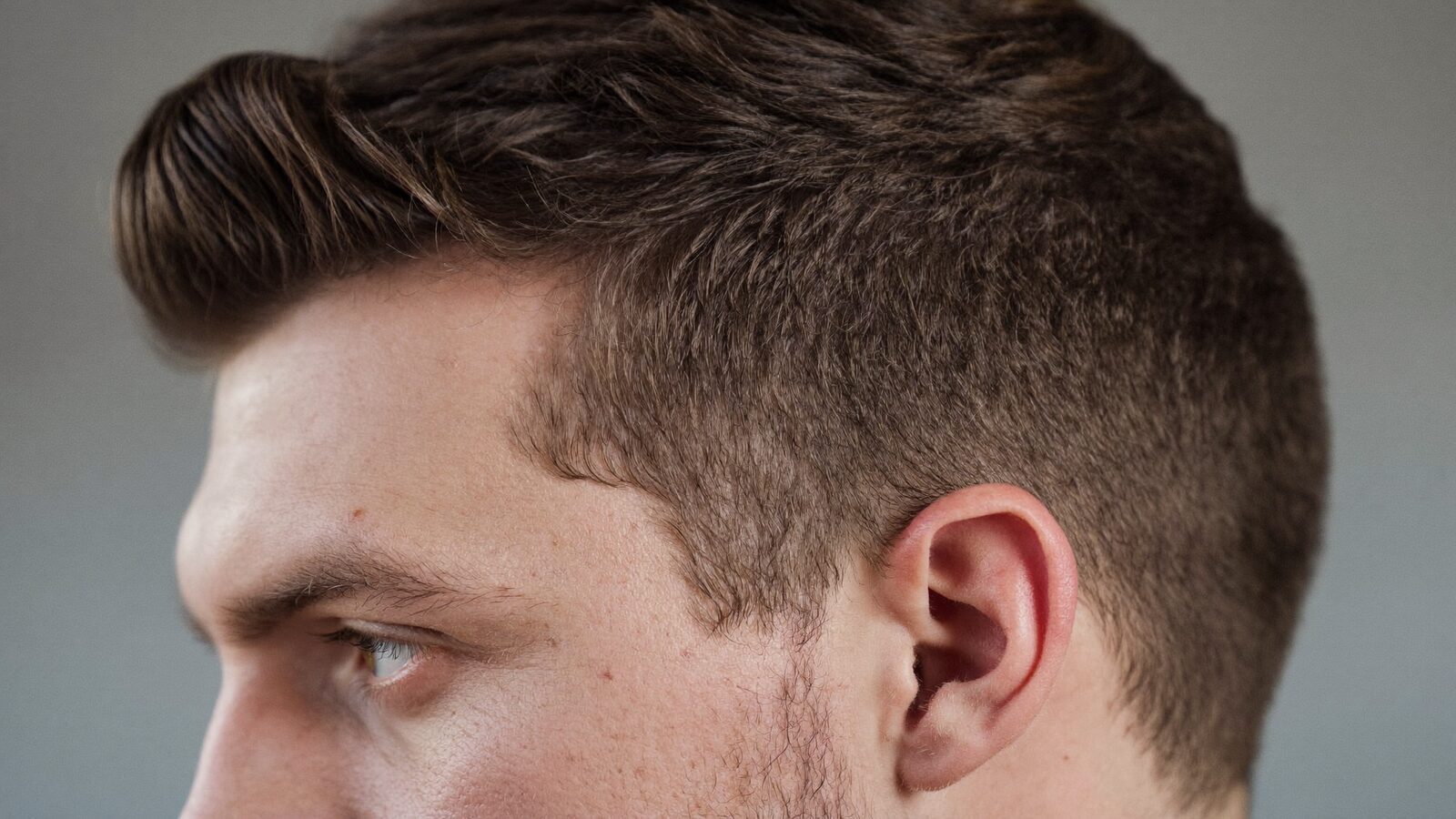
Temple point restoration rebuilds the small, pointed patches of hair that sit above each ear and in front of the sideburns, using individually placed grafts. When these points recede or vanish, the face loses its side frame, even if the front hairline looks fine. Most men need roughly 150 to 400 grafts per side, placed at very flat angles, and the work is usually done with FUE as part of a broader hairline plan.
Temples are one of the most overlooked areas in hair restoration. Patients tend to focus on the frontal hairline or the crown, and only notice the temple points when they look at an old photo and see how much wider and softer their face used to look. This guide explains what temple points are, why they change the frame of the face, and what restoring them involves.
Key takeaways
- Temple points are the triangular hair patches above the ears that connect the sideburns to the frontal hairline.
- Restoring temple points typically takes about 150 to 400 grafts per side, depending on how much has receded.
- Temple hair grows almost flat against the skin, so grafts must be placed at very low angles to look natural.
- Mostly single-hair grafts are used at the temples because the area needs fine, soft hair rather than bulk.
- Temple work is often combined with a frontal hairline or used to soften a high forehead in women.
What are temple points?
Temple points are the small triangles of hair that project forward from the side of the scalp, above and slightly in front of each ear. They sit between the sideburns and the recessed corners of the frontal hairline. On a full head of hair, temple points point toward the eyes and visually close the gap between the forehead and the side of the head.
It helps to separate two terms that people often confuse. The temporal recession, or temple corners, describes the receding area at each end of the front hairline. The temple points are lower and further back, sitting on the side of the head. A person can lose one without the other, and each needs a different design approach.
Temple points can thin from genetic hair loss, usually later than the corners of the hairline. They can also be lost after facelift surgery, from traction caused by tight hairstyles, or simply from aging. On the Norwood scale, a common system that grades male pattern baldness from 1 to 7, temple points tend to erode in the more advanced stages.
Why do temple points matter for the face?
Temple points matter because they form the side frame of the face. When they are present, the face looks narrower at the top and more balanced from the front and side. When they recede, the forehead appears taller and wider, the eyes look less framed and the overall look often reads as older than the person really is.
Think of a picture frame missing its side pieces. The picture is still there, but the edges feel unfinished. Temple points do the same job for your face. Many patients who have already had a frontal hairline restored notice that something still looks off, and the missing piece turns out to be the temples.
The effect is especially clear in profile and in three-quarter views, which are how most people see us in daily life. Restoring even a modest temple point can soften a strong brow line, reduce the appearance of a high forehead and connect a new hairline to the sideburns so the transition looks natural. You can see examples of framed hairlines in our before and after gallery.
Design note: Temple points should match your age and face shape. Overly sharp, low or dense temples can look artificial, so the design usually aims for a soft point that blends into the existing sideburn.
Graft angles and density
Graft angle is the single most important technical detail in temple point restoration. Temple hair grows almost parallel to the skin, often at 10 to 20 degrees, and points down and slightly backward toward the ear. Grafts placed too upright stick out and look tufted, which is one of the most common signs of poor temple work.
The direction also changes across a very small area. Near the sideburn, hair tends to grow downward. Higher up, it turns toward the back of the head. Our team maps those directions before any incisions are made, then creates each recipient site at the matching angle so the new hair lies flat and follows the natural flow.
Density is the second consideration. Temple points are a fine-hair area, so the work relies mainly on single-hair grafts, sometimes with a few two-hair grafts at the back of the zone. Density is built gradually from the soft edge to a slightly fuller center, which avoids a harsh line.
- Angle: very acute, usually close to flat against the skin.
- Direction: downward and backward, changing as the zone rises.
- Graft type: mostly single-hair grafts for softness.
- Edge design: irregular, feathered borders rather than a straight line.
- Donor match: finer hairs from the nape or the sides of the donor area often blend well.
How many grafts does temple point restoration take?
Temple point restoration usually takes about 150 to 400 grafts per side, or roughly 300 to 800 in total. The number depends on how far the temples have receded, the size of the point you want and your hair caliber. Coarse, dark hair covers more with fewer grafts, while fine or light hair may need more.
| Situation | Typical grafts per side | Common approach |
| Mild softening of an existing point | About 100 to 200 | Single-hair grafts along the edge |
| Rebuilding a faded point | About 200 to 350 | Singles at the border, a few doubles behind |
| Fully absent temple point | About 300 to 400 | Full redesign, often with the frontal hairline |
| Temple work alongside a full hairline | Varies with the overall plan | Part of a larger session, up to about 4,000 grafts in one day |
Because the area is small and precise, temple work often fits into a session that also addresses the frontal hairline. If your plan is large, our team may split it into two sessions. Donor reserve is always protected, so temple grafts are never taken at the expense of future needs.
Pricing follows the graft count: $3.99 to $7.99 per graft, with most full procedures falling between $4,000 and $15,000. A small temple-only session sits at the lower end, and you receive a written quote after a free consultation.
Temple work for women
Temple work for women usually aims to soften the sides of the forehead rather than create a pointed shape. Many women have naturally rounder temple areas, and thinning there can make the forehead look larger. Carefully placed single-hair grafts can rebuild a gentle curve that frames the face without looking masculine.
Women often seek temple restoration after years of tight ponytails or braids, which can cause traction thinning at the temples. Others notice the change after facelift or brow surgery shifts the hairline. Hormonal and genetic factors can also play a role, so the cause needs to be understood before any grafting is planned.
Some women combine temple grafting with a broader hairline or forehead-reduction plan. Our hairline lowering guide compares surgery and grafts for a high forehead, and the female hair transplant page explains how planning differs for women.
Who is a good candidate for temple restoration?
A good candidate for temple restoration has stable hair loss, enough donor hair and realistic goals for the size and shape of the temple point. Adults whose hair loss has slowed, and who are comfortable with a gradual result over 12 months, usually do well. Very young patients may be advised to wait.
The reason for caution with younger patients is that hair loss often continues. Rebuilding temples at 22 can leave an island of hair if the surrounding area keeps thinning. Medication to slow loss is often discussed during planning, and the design leaves room for future changes. Our guide on who makes a good hair transplant candidate covers these factors in more detail.
Patients who have lost temple hair from scarring, such as after cosmetic surgery, can also be candidates, although scar tissue may need a test session or a more conservative density at first.
What to expect from planning to final result
The temple point restoration process runs from a consultation and design session, through a single procedure day, to a final result at about 12 months. Most patients return to desk work within a few days, and the new hair begins to show around months 3 to 5 before filling in steadily.
- Consultation: Dr. Jeffrey Spiegel, MD reviews your hair loss, donor area and goals, then designs the temple shape with you.
- Procedure day: the area is numbed with local anesthesia, grafts are extracted by hand and placed by our team under the doctor's oversight. You go home the same day.
- First two weeks: small scabs form and fall away, and mild swelling near the eyes is possible because of the temple location.
- Months 1 to 3: the transplanted hairs usually shed, which is normal, and the area looks similar to before.
- Months 4 to 12: new growth thickens and the temple point takes shape, with 12 months of follow-up included.
If you have been wondering why your hairline still looks unfinished, a temple assessment is a simple place to start. Visit our Newton clinic on Route 9 for a free consultation and a written plan.
Frame Your Face with Natural Temple Points
Book a free consultation in Newton for a temple assessment, a custom design and a written, per-graft quote.