
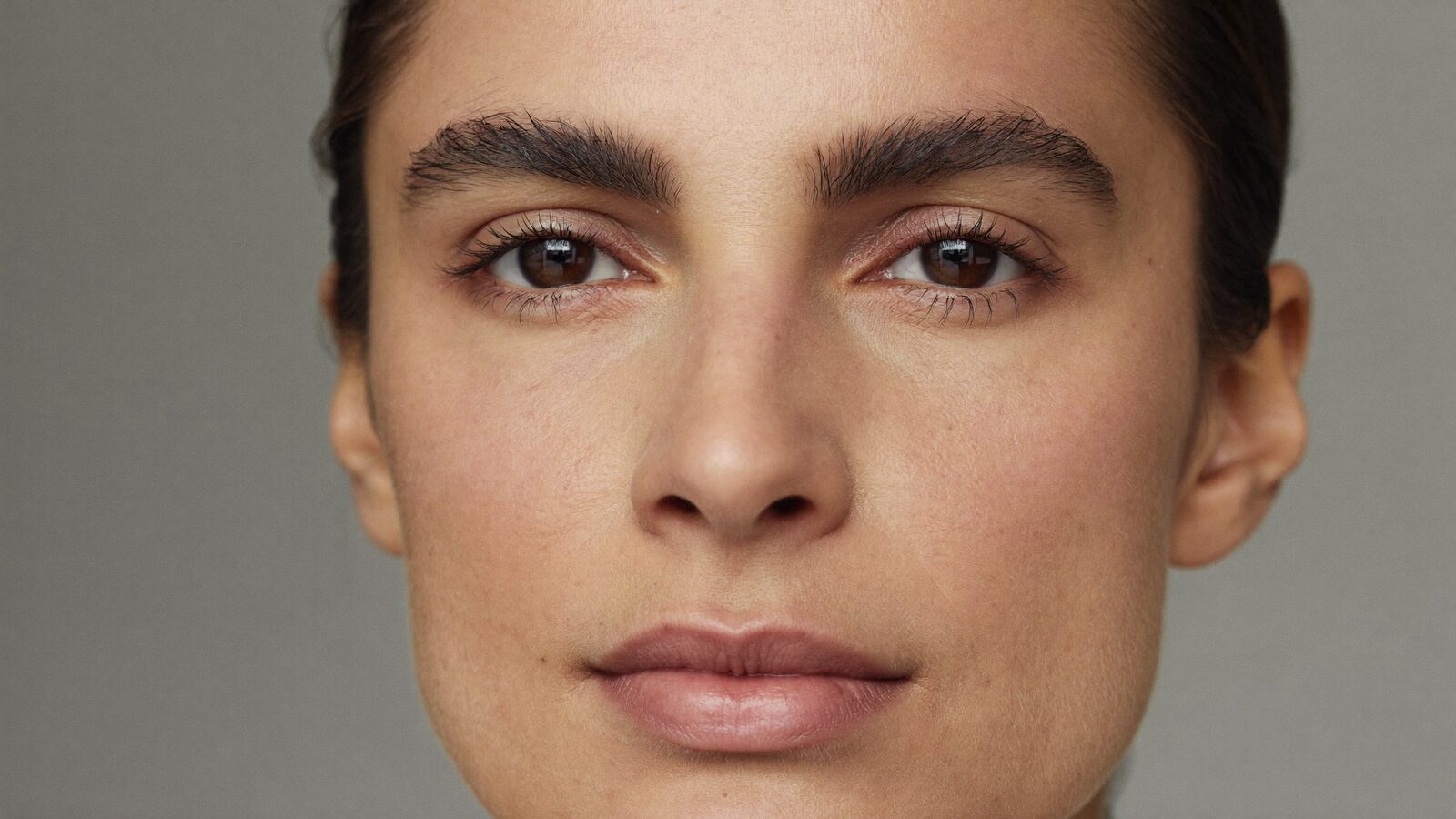
This eyebrow transplant guide starts with the short answer: an eyebrow transplant moves individual hair follicles, usually from the back or sides of the scalp, into the brow area to rebuild shape and density that plucking, scarring or thinning has taken away. The new hairs are permanent and grow like natural brows, but they need regular trimming.
Below we cover who tends to benefit, how a brow is designed before any graft is placed, why angle and direction decide whether the result looks real, what trimming involves, and how brow work compares with beard restoration. If you already know you want to explore treatment, our eyebrow transplant page explains the procedure at our Newton clinic.
Key takeaways
- Eyebrow transplants usually use single-hair grafts, often a few hundred per brow, taken from the scalp.
- Grafts are placed almost flat against the skin and follow the natural direction of brow hair, which changes from the inner brow to the tail.
- Transplanted brow hair keeps some scalp-hair behavior, so most patients trim it every one to two weeks.
- New brow hairs typically start growing at 3 to 4 months, with the full result visible at around 9 to 12 months.
- Active hair loss conditions affecting the brows should be stable before any transplant is considered.
Who do eyebrow transplants help?
Eyebrow transplants help people whose brows are sparse because of a lasting cause: years of over-plucking or waxing, scars from injury or surgery, gaps that were simply never full, or thinning that has stayed stable for some time. The procedure tends to work well when the brow area is healthy skin and the scalp offers a fine donor supply.
The most common story is over-plucking. Follicles pulled repeatedly over many years can stop producing hair altogether, and no amount of serum brings them back. Scar tissue from a cut, burn or past surgery is another frequent reason, because scars do not grow hair on their own.
Some patients simply want a fuller or better-shaped brow than nature gave them. Others have used microblading or brow tattoos for years and would like real hair instead. Grafts can often be placed through faded pigment, though the plan depends on the tattoo's color and depth.
When an eyebrow transplant is not the right first step
- Active alopecia areata: patchy autoimmune hair loss can attack transplanted hair too, so the condition should be quiet and assessed first.
- Frontal fibrosing alopecia: this scarring condition often affects the brows and needs medical management and a long stable period before grafting is discussed.
- Thyroid or nutritional causes: brow thinning from an untreated medical issue may improve once the cause is addressed.
- Ongoing hair pulling: grafts will not hold up if the pulling habit continues, so support for that comes first.
How is the brow shape designed?
Brow shape is designed before the procedure by drawing the proposed outline directly on the face, adjusting it in the mirror with the patient, and checking it against facial proportions such as eye spacing, brow bone and forehead height. A good design looks like the patient's own brow on a good day, not a trend.
At Nova Medical Boston, Dr. Jeffrey Spiegel, MD, a board-certified facial plastic and reconstructive surgeon, designs the plan with you and reviews the outline before anything is approved. Facial plastic surgery training puts real weight on symmetry and proportion, which matters a great deal on a feature as visible as the brows.
Brows are naturally slightly different from each other, so the goal is balance rather than a mirror copy. Most designs place the inner brow roughly in line with the side of the nose, the highest point (the arch) around the outer third, and the tail tapering toward the outer edge of the eye. Shape also depends on sex, age and personal style: many men prefer a straighter, lower brow, while many women prefer a defined arch.
Design tip: Bring a few photos of your brows from years when you liked them, plus a current photo with no makeup or pencil. Real references from your own face are far more useful than celebrity images. Our post on celebrity-inspired hairlines explains why borrowed shapes rarely translate one to one.
Graft angle and direction: why they make or break the result
Graft angle and direction are the main technical difference between a natural eyebrow transplant and an obvious one. Brow hairs grow almost flat against the skin, at a very low angle, and their direction shifts across the brow. If grafts are placed too upright or all pointing one way, the brow looks spiky and artificial.
A natural brow has three zones. Hairs at the inner end (the head) tend to point upward and slightly outward. Hairs in the middle (the body) run outward, with upper hairs angling slightly down and lower hairs angling slightly up so they meet in a soft central line. Hairs in the tail point outward and gently downward.
To copy that pattern, the team makes very small recipient sites at a shallow angle and places one-hair grafts one by one. Using single-hair grafts matters, because two- and three-hair groupings, which are useful on the scalp, look clumpy in a brow. Grafts for brows are usually taken from finer hairs at the back or sides of the scalp, often near the nape or behind the ears, using manual FUE (follicular unit extraction, where each follicle is removed individually with a fine handheld instrument).
Typical graft numbers
| Goal | Typical grafts per brow | Common reasons |
| Filling small gaps or a scar | Roughly 50 to 150 | Old injury, a single over-plucked patch |
| Thickening a thin but complete brow | Roughly 150 to 250 | Gradual thinning, wish for more density |
| Rebuilding most of the brow | Roughly 250 to 400 | Long-term over-plucking, very sparse brows |
These are typical ranges, not quotes. The actual number depends on the size of the brow you want, the density you are aiming for and how much existing hair remains.
Do transplanted eyebrow hairs need trimming?
Yes, transplanted eyebrow hairs need trimming because they come from the scalp and keep much of the scalp's growth cycle. Scalp hair has a long growing phase, so the new brow hairs can grow longer than native brow hair. Most patients trim them with small scissors every one to two weeks.
Some people find that transplanted brow hair settles and grows a little more slowly after the first year or two, but it is wise to plan on trimming as an ongoing part of grooming. Many patients compare it to shaping a beard: a quick routine that keeps the brow tidy.
- Use small, rounded brow scissors: they are safer near the eyes than nail scissors.
- Brush up, then trim: comb hairs upward with a spoolie, trim what extends past the brow line, then brush back down.
- Use a little brow gel: it helps train the hairs to lie in the direction they were placed.
- Do not pluck transplanted hairs: plucking can damage the very follicles you paid to move.
What is recovery like after an eyebrow transplant?
Recovery after an eyebrow transplant is usually quick. The procedure takes a few hours under local anesthesia, you go home the same day, and small crusts around each graft generally fall away within about a week. Mild swelling around the eyes is common for a few days, and most people return to work within days.
The transplanted hairs often shed within the first few weeks, which is normal. New growth typically appears at around 3 to 4 months and continues to thicken through 9 to 12 months. The donor area at the back of the scalp is small and usually hidden by surrounding hair within a week or two.
Because the brow sits close to the eyes, the aftercare focuses on keeping the area clean, avoiding rubbing, skipping brow makeup for about a week and protecting the skin from strong sun. Your written aftercare instructions cover each of these steps in detail, and 12 months of follow-up gives you time to check progress as the hair grows in.
Eyebrows vs beards: what differs between the two procedures
Eyebrow and beard transplants both move scalp follicles into facial skin, but they differ in scale, graft type and design. A brow typically needs a few hundred single-hair grafts placed at a very flat angle, while a beard can need well over a thousand grafts covering a larger area with mixed one- and two-hair grafts.
| Factor | Eyebrow transplant | Beard transplant |
| Typical graft count | A few hundred per brow | Often 1,000 to 3,000 or more, depending on coverage |
| Graft type | Almost entirely single-hair grafts | Mostly single-hair, some two-hair grafts in denser zones |
| Placement angle | Very flat, with direction changing across the brow | Low angle, following the downward and forward flow of facial hair |
| Ongoing grooming | Trimming every one to two weeks | Shaved or trimmed like any beard |
| Session length | Usually a few hours | Often a full day for larger areas |
Beard work also gives more freedom with density, because a beard can be worn short, long or shaved, and slight variations blend in. A brow is a small, central feature that people look at in every conversation, so design precision matters more than graft volume. If you are weighing both, our guide to beard transplant cost and healing time covers the beard side, and our beard transplant service page explains how facial hair restoration is planned.
Questions to ask before booking an eyebrow transplant
Before booking an eyebrow transplant, ask who designs the brow shape, who places the grafts, how many single-hair grafts are planned per brow, where the donor hair comes from and what follow-up is included. Clear answers to those questions say more about the likely result than any brochure photo.
- Who draws and approves the design? At our clinic, the doctor reviews and approves every plan.
- How many grafts per brow, and why? The number should match your goal, not a package size.
- Can I see healed brow results? Ask to see examples in our patient gallery and at your consultation.
- What is the written price? Pricing is per graft, $3.99 to $7.99, with a written quote after a free consultation and 0% financing for the first 12 months.
- What happens if a brow needs refining later? Ask how touch-ups are handled after the 12-month review.
Brows that frame the face well can change how rested and expressive you look, which is why some patients pair brow planning with other facial framing work. Our post on temple point restoration covers a related area where small, precise grafts make a visible difference.
Talk Through Your Brow Goals
Book a free consultation in Newton to see a proposed brow shape, a graft estimate and a written quote before you decide.